The following is a repost of my review of Oppenheimer (2023), originally shared here on Letterboxd.
The A-Bomb Under the Table
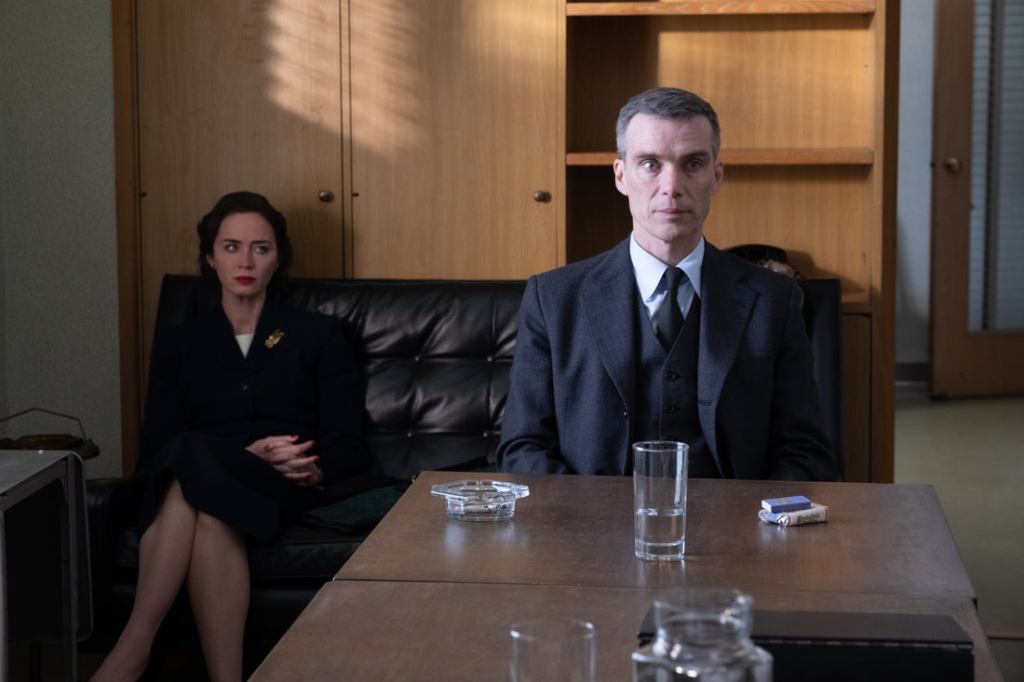
Here is an old Hitchcockian proverb. Two men sit at a table, having a conversation. At the end of it, a bomb under the table goes off, to the audience’s surprise. Instead, let’s show the audience that there is a bomb under the table from the beginning. Now two men sit down to have their conversation, unawares. The audience may no longer be surprised when the bomb goes off at the end of the scene, but instead they are engaged and invited into the suspense for the duration. And let’s be real: they’ll probably still be surprised when the bomb goes off too. Loud and sudden noises in a dark, cramped theater. While half of the suspense in Christopher Nolan’s Oppenheimer is fittingly derived from the bomb we know must go off before the movie’s end, perhaps the greatest surprise this movie has to offer is that the other half of the suspense is derived from the table itself, and the angry men sitting around it.
We will look at how Nolan’s trademark cross-cutting and non-linearity creates the self-sustaining chain reaction of suspense between these two halves, between table and bomb. But let’s get something else out of the way first. A weakness of Nolan’s is his apparent inability to write women or people of color of any consequence or depth of character in his films. Despite all his cinematic boundary pushing, he is very British conservative in terms of his heroes and the casting of them. Part of this is the stories he often chooses to tell; Dunkirk was a (great) story about 400,000 white men waiting in line on a beach. Demographically, Oppenheimer essentially tracks with that, minus the beach. I agree that it did not have to be, and I even agree on the point that his prior films mostly seem to have this deficiency in common. However, while the matter seems to be chalked up to just that–deficiency–in his previous films, here it does comment (whether intentionally or unintentionally) on how often white men in America sitting around a table can so shamelessly take global stakes into their own hands, just because they believe they should. If there is anything to take away from Oppenheimer it is that men will volley idea after dangerous idea at each other in search of power regardless of the consequences it has for the rest of the world. There is a lot of insidious evil going on in this movie, and it’s probably accurate for once that the film (again, intentionally or otherwise) essentially forces us to ascribe the blame to the angry men at the table, there being so few other kinds of characters for us to watch. Nolan . . . we’re still waiting on characters of greater depth and diversity in your future films.
Anyways, back to the A-Bomb under the table.
This film owes its success to editor Jennifer Lame. What impressed me most about this film from start to finish was how Lame’s precise execution of Nolan’s cross-cutting non-linearity is essentially sustained for the full duration. It is in this way more than any other that the film feels like the culmination of his whole career. There are very few scenes in the traditional sense when the film focuses on one time and place long enough to achieve a singular purpose. The film feels like a three-hour montage, packing information in from start to finish, cutting between Oppenheimer’s colorful past and present, as well as the perspective of Louis Strauss in black-and-white. While Nolan’s trademark non-linear structures have been at times more confounding than convincing, it is here in Oppenheimer that they feel the most masterful and intentional. They feel the result of expertise, of macroscopic vision and most importantly purpose rather than of novel plot experimentation. Images, moments in time, anecdotes from across Oppenheimer’s life cut from past to present to future to Strauss with ease, from universities in Europe to family dinners to the Manhattan Project to a cramped conference room to the halls of Washington D.C. It’s overwhelming. It’s overstimulating. It’s a constant stream of information. And it all works, because it all has a purpose: to create sustained, three-hour, suspense around the most fearsome moral quandary in the history of warfare, in the history of science, perhaps in the history of mankind. Not an exaggeration made lightly.
The constant skipping between times and places, images, and events–to an extent that even Kuleshov himself would consider nightmarish and perverse–serves to constantly keep the bomb under the table in the mind of the audience as it cuts back to the conversation happening above it. Of course, there are more bombs in this film than one. We see Oppenheimer’s journey toward building the bomb intercut with the interrogations meant to deny him of his security clearance, effectively neutering his post-bomb influence and attempts to put the genie back in the bottle. This brings us to another surprising side to this film. The film is just as much about mid-century American communism as it is about the Manhattan Project itself. It explores the spread of that communism and the McCarthyist Cold War aftermath in perhaps equal measure to the business surrounding the bomb. It handles the moral dilemmas of both bomb and commie with a surprisingly nuanced detachment for a film so mainstream, by such a mainstream auteur. Frankly, I was surprised by the degree to which that detached nuance guides the film’s outlook, in the handling of issues that are so hot-button in Western society and presented so often with one-sided determination. I digress.
If the Trinity Test is the center of this film, then the security clearance hearing is the backbone. It motivates all of the cross-cutting and non-linearity that takes place, the whole structure of the film. The revoking of the security clearance is the final Hitchcockian bomb to go off under the table. It’s surprising the climactic power that moment is given and the driving force with which the rest of the film leads up to it, given this is the same film that depicts the turning of the Los Alamos desert to glass. Indeed, at the emotionally-charged peak of the hearing’s throughline toward the end of the film, Oppenheimer envisions the bomb going off, as if hallucinating the event. Light consumes the table and all the angry men situated around it, before the sound swallows everyone whole in all its 70mm IMAX terror. Yes, the cross-cutting is more overwhelming and more overstimulating than perhaps any other film I have ever seen. There is a lot of talking. It’s mind-blowing, trying to reconcile the information of the hearing, seemingly far away, while still viewing the events of Oppenheimer’s early career, way back at the chronological start of his story. But it is not random. Far from it. The pattern is Bomb-Table-Bomb-Table all the way through.
Taking Oppenheimer’s life as a whole, the film shows us moments that feel like happenstance leading up to the bomb–encounters with friends, family, lovers, many with ties to Communism–then shows us the moment that happenstance came to damn him during the hearing after the bomb. Again, the cycle becomes a self-sustaining chain reaction for the audience to internalize, until our brain automatically begins to sense the danger in those chance meetings, encounters, and conversations of his past. When more marbles are dropped into the bowl, we feel suspense and fear because we know it brings us closer to the bomb at the film’s center. And at a certain point in the film, we begin to instinctively feel suspense and fear when watching the indiscretion of Oppenheimer’s early career with his communist associates, because we know it brings us closer to the fateful table at the end of the film, to the political entrapment of the man behind the world’s first nuclear weapons as he fights to platform himself as one of our first non-proliferationists.
This is the magic trick of Oppenheimer, and it is a testament to the vision and talents of the cast and crew: that through some of the most ambitious non-linear editing and storytelling our generation has seen, these angry men around a conference table in Washington become the surprising climax of a film we all thought would be strictly about the angry men in the laboratories of Los Alamos. God knows, the angry men fighting for the power to drop the bomb were more dangerous than the Gadget itself.
 JMW Writes
Leave a comment